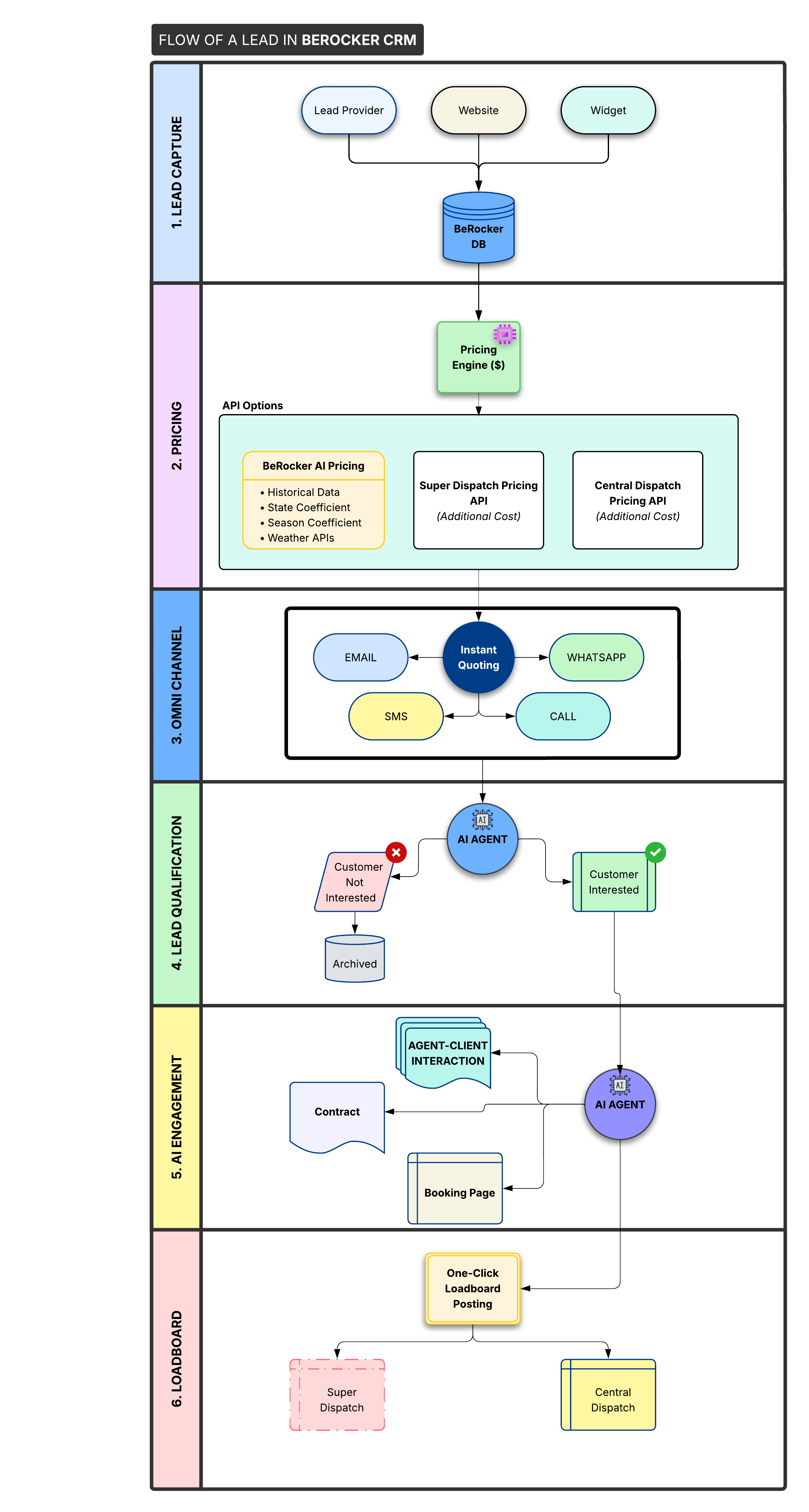
The statuses
On the Shipments screen, Order, Signed and Paid are folded into a single Order tab
so the tab bar stays short. The individual statuses are still there — use the sub-filters inside
the tab to split them.
Milestones are not statuses
Alongside the status, a shipment carries three milestones: Quoted, Signed and Paid. They show as small check chips in the Shipments table. Milestones are facts that accumulate — a lead that was quoted stays quoted forever. They are worked out from records that already exist (the quote message that went out, the signed contract, the successful payment), so they cannot go stale and nobody has to set them by hand. That is why a lead can be Posted and still show ✓ Quoted ✓ Signed ✓ Paid.Stage by stage
1
The lead arrives
From a lead source (your website or a provider posting to your
endpoint), from email parsing, or added by hand with + Add
Shipment.Lead distribution decides which agent gets it, based on the daily
quotas you set per agent and per source.A conversation is created at the same time, so the lead appears in both Inbox and
Shipments.
2
You quote it
Open the conversation and send a quote. The price comes from your
pricing engine — BeRocker AI, Super Dispatch’s recommended price, or
Central Dispatch’s price — adjusted by your correction factor.The wording comes from your Quote templates. Keep several versions of
each so customers who get quoted twice do not get identical texts.The lead now shows ✓ Quoted. In the New tab it moves from Not Quoted to Quoted.
3
You follow up
Most customers do not answer the first message. Two things chase them for you:
- Follow-up sequences — a timed ladder of messages you build once in Templates → Follow-up.
- Triage — reads every live conversation and sorts it into Rescue / Close / Waiting / Cold / Healthy, so you spend the day on the ones a human can actually move.
4
The customer books
They open your booking page, confirm the details, sign the agreement
and pay the deposit.Status → Order, then Signed, then Paid as each piece lands. If automatic payments
are on, the card is charged on booking.
5
You post the load
From the shipment’s Carrier tab, post to Central Dispatch and/or Super Dispatch without
leaving the CRM. Status → Posted.Carrier offers come back into the same tab. The Posted tab splits into No Offers and
Has Offers so you can see which loads are not getting attention.
6
You dispatch a carrier
Accept an offer, or dispatch a carrier directly. Status → Dispatched.If you have it turned on in
Carriers and Loadboards, BeRocker automatically unposts the
load from the other board once a carrier is secured, so you are not fielding calls on a load
that is already covered.
7
The load moves
Pickup and delivery come back from the load board and move the status to Picked Up and
Delivered. The matching customer messages go out automatically if those template events are
active.Watch it on the Dispatch map, which shows live GPS where Super Dispatch
reports it and an estimated position where it does not.
8
Money and close-out
Every charge, refund and fee is in Accounting. Once the balance is settled,
close the shipment out as Completed.
Finding what needs doing
You do not have to remember any of the above. The sub-filters on the Shipments screen answer it for you:
And Follow up → Triage answers the other half — which conversations need a
human today, ranked by how much money is riding on them.
The older overview
The original process-flow diagram is still available if you prefer it: